Bonjour
There hasn’t been a lot to write about since the last post.
Clio wasn’t in the mood for going anywhere, but a new battery has sorted that out. So we took her for a spin to Saint Vaast la Hougue, a famous fishing and sailing port. There is a spot of land just off the shore, which is a peninsular or an island, depending on the tide. You can walk across at low tide or catch the amphibious vehicle. We didn’t do either because it was a wet miserable day. Maybe next time.

The other place we visited that has been on our list was the La Cambe German Military cemetery (one of six located in Normandy). During the war this area was where two battlefield cemeteries were located next to each other for both German and American soldiers, sailors and airmen. After the war the American graves were exhumed and the remains returned to U.S. or buried at the nearby American Cemetery (depending on the wishes of the family). La Cambe was then formally recognised as a German War Cemetery and the remains of a further 12,000 German soldiers who were buried in over 1,400 scattered locations have now been transferred here. They are still discovering graves around the countryside and each time a formal reburial takes place, although these are rare nowadays.

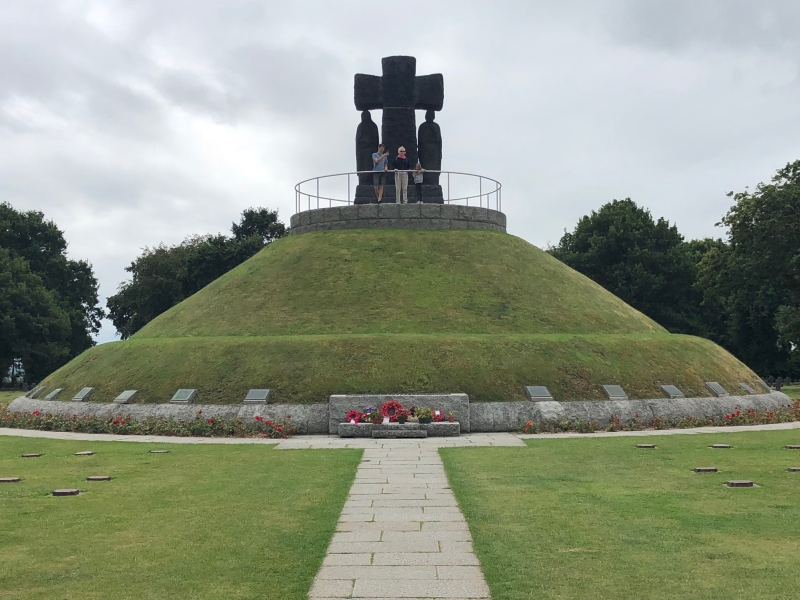
Unlike the American and Commonwealth War Graves Commission, the German cemetery is maintained solely by donations of money and labour. Some bright spark put out the word to Americans of German descent for donations and this proved very successful with development of the cemetery advancing much more rapidly than they expected.
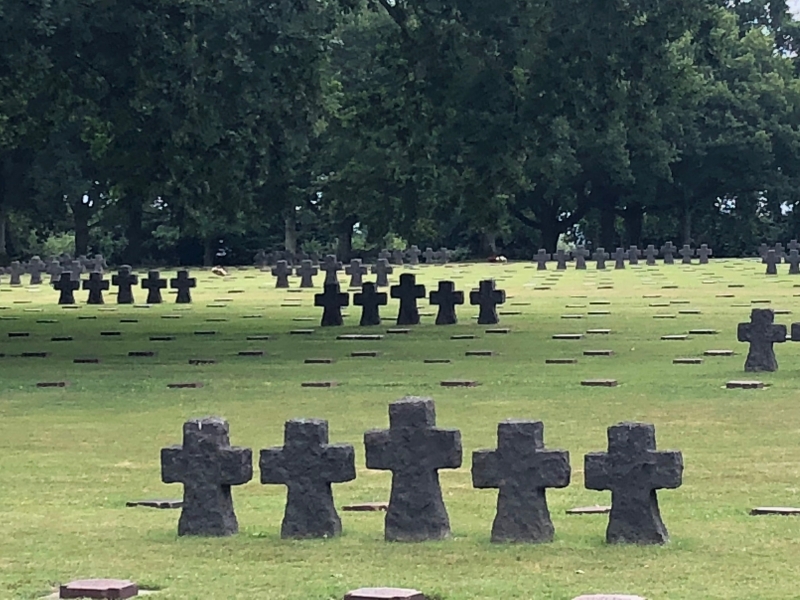


Having visited the American War Cemetery a few months ago, there is a distinct difference between both places. It’s hard to describe, but the American cemetery is all ‘spit and polish’, pristine paintwork, immaculate grounds and coastal views. While both are very dignified and respectful, the German version, which is next to a main highway, is very memorable with its austere simplicity. Probably their budget has a bit to do with it.
Apart from that, other news from Cherbourg is the arrival of the Galleon Andalucia, a replica of a 18th century galleon boat that sails around the world and ‘carries out knowledge transfer and promotion actions’. Whatever that means. It looks like something out of Pirates of the Caribbean but no Johnny Depp in sight.
C’est tout.
L & M.
 thefrenchfeed